
Dave is an electrician with three vans, a decent reputation and no time. When his old website finally broke, he did what plenty of busy owners do. He posted in a local Facebook group, picked the cheapest of the replies and paid half up front. The site went live six weeks later. It looked fine. Then the developer stopped answering messages, the hosting bill arrived in someone else’s name and, eight months on, Dave found out he didn’t own his own web address.
Dave is a composite, but his story is one we hear in some form almost every month. The problem wasn’t that he chose a freelancer, or that he tried to keep costs down. It was that nobody told him what to check before he said yes.
This guide is that conversation. It explains the different types of website developers for small business owners, where to find good ones, what they cost in the UK and a simple five-step process for choosing well. If you only want the questions to ask on a call, our list of 20 questions to ask a web designer covers those in depth. This guide is about the bigger decision around them.
Key takeaways
- Website developers for small business come in four main types: freelancers, small agencies, platform specialists and large agencies. Most local businesses are best served by the first two.
- Expect to pay £1,000 to £3,000 for a freelancer and £3,000 to £10,000 for a small agency, with simple sites from around £500.
- Shortlist three, compare them on the same written brief and check live sites, not portfolios.
- Make sure the domain, hosting and logins are in your business’s name before any work starts.
- The best developer is the one still answering your emails a year after launch.
Web designer or web developer: does it matter?
Strictly speaking, a designer decides how a site looks and a developer builds it. In practice, most people who build sites for small businesses do both, and you will see the terms used interchangeably.
What matters more is whether the person or team covers the whole job: planning, words, design, build, SEO basics, hosting and support. A brilliant coder who leaves you to write every word and sort your own hosting may not be the right fit, even if the site works perfectly.
The four types of website developers for small business
Each type suits a different budget and a different kind of business. None is automatically better.
Freelance developers
One person, usually working from home, often with a network of others they bring in for copy or photography. Good freelancers are flexible, personal and good value. The risk is that everything depends on one person. If they get ill, busy or bored, your project waits.
Best for: brochure sites, local trades, cafés, salons and consultants who want five to fifteen pages done well.
Small agencies
A team of two to fifteen people, often with a mix of design, development, SEO and support skills. You get more resilience and usually a clearer process, at a higher price than most freelancers.
Best for: businesses that need strategy, integrations, booking systems or ongoing SEO alongside the website.
Platform specialists
Developers who work only on one platform, such as Shopify, Squarespace or WordPress. They know that platform inside out and can move fast. Just make sure the platform is right for you before you hire someone whose answer will always be the same.
Best for: online shops and businesses that have already chosen their platform.
Large agencies
Big teams, big clients and big minimum budgets. Occasionally a good fit for a fast-growing small business, but usually more than you need, and your project may end up with their most junior staff.
Best for: well-funded businesses with complex needs and an in-house marketing team.
Freelancer or small agency: a quick comparison
Most owners end up choosing between these two, so here is how they stack up side by side.
| Freelancer | Small agency | |
|---|---|---|
| Price | Lower | Higher |
| Speed of reply | Fast, until they’re busy | Usually steady |
| Range of skills | Narrower | Design, build, SEO, support |
| Risk if someone leaves | High | Lower |
| Personal service | Very personal | Personal, with a team behind it |
Neither column wins outright. Pick the one that matches how much help you need after launch, because that is where the differences between website developers for small business really show.
What do website developers for small business cost?
These are typical UK prices charged by website developers for small business projects. Your quote will depend on the number of pages, who writes the copy and what the site needs to do.
| Type of developer | Typical UK cost | What you usually get |
|---|---|---|
| Freelancer | £1,000 to £3,000 | Brochure site, contact forms, SEO basics |
| Small agency | £3,000 to £10,000 | Planning, custom design, integrations, support |
| Platform specialist | £1,500 to £8,000 | Shop or site built on one chosen platform |
| Large agency | £15,000 and up | Strategy, research, complex builds |
Don’t forget the running costs: hosting, domain renewal, updates and support usually add £150 to £600 a year. Our full guide on how much a website costs in the UK breaks these down line by line.
Where to find good website developers for small business
Facebook groups aren’t always a bad place to start, but they reward whoever replies fastest, not whoever is best. The best website developers for small business are often busy and rarely the first to reply. These routes tend to produce better shortlists:
- Ask businesses you admire. If a local firm has a site you like, scroll to the footer or ask who built it. Most owners are happy to tell you, and you get a review at the same time.
- Search Google for your area. Try “website design” plus your town or county. A developer who ranks well locally has shown they understand SEO.
- Check Google reviews. Look for reviews that mention support after launch, not just the launch itself.
- Ask your accountant or business network. They see which suppliers their clients stick with.
- Look at the work pages, then click through to the live sites. Screenshots can hide a lot.
If you are based in the North East, our page on website design in the North East explains how we work with local businesses, though plenty of good developers work entirely remotely too.
How to choose between website developers for small business: a 5-step shortlist
This is the process we would follow if we were in your shoes. It takes a couple of weeks and saves months of regret.
Step 1: Write a one-page brief
Before you contact anyone, write down what your business does, who your customers are, the one main thing you want the website to do and your rough budget. Add three websites you like and say why. A short brief makes quotes comparable and shows developers you are serious.
Step 2: Shortlist three developers
Fewer than three website developers for small business and you can’t compare. More than three and you will drown in calls. Pick from the routes above and send each the same brief.
Step 3: Check the live work
Open three of their recent sites on your phone. Are they fast? Is it obvious what each business does and how to get in touch? Would you trust them with your money? Run one through PageSpeed Insights if you want a second opinion on speed.
Step 4: Compare written quotes, not conversations
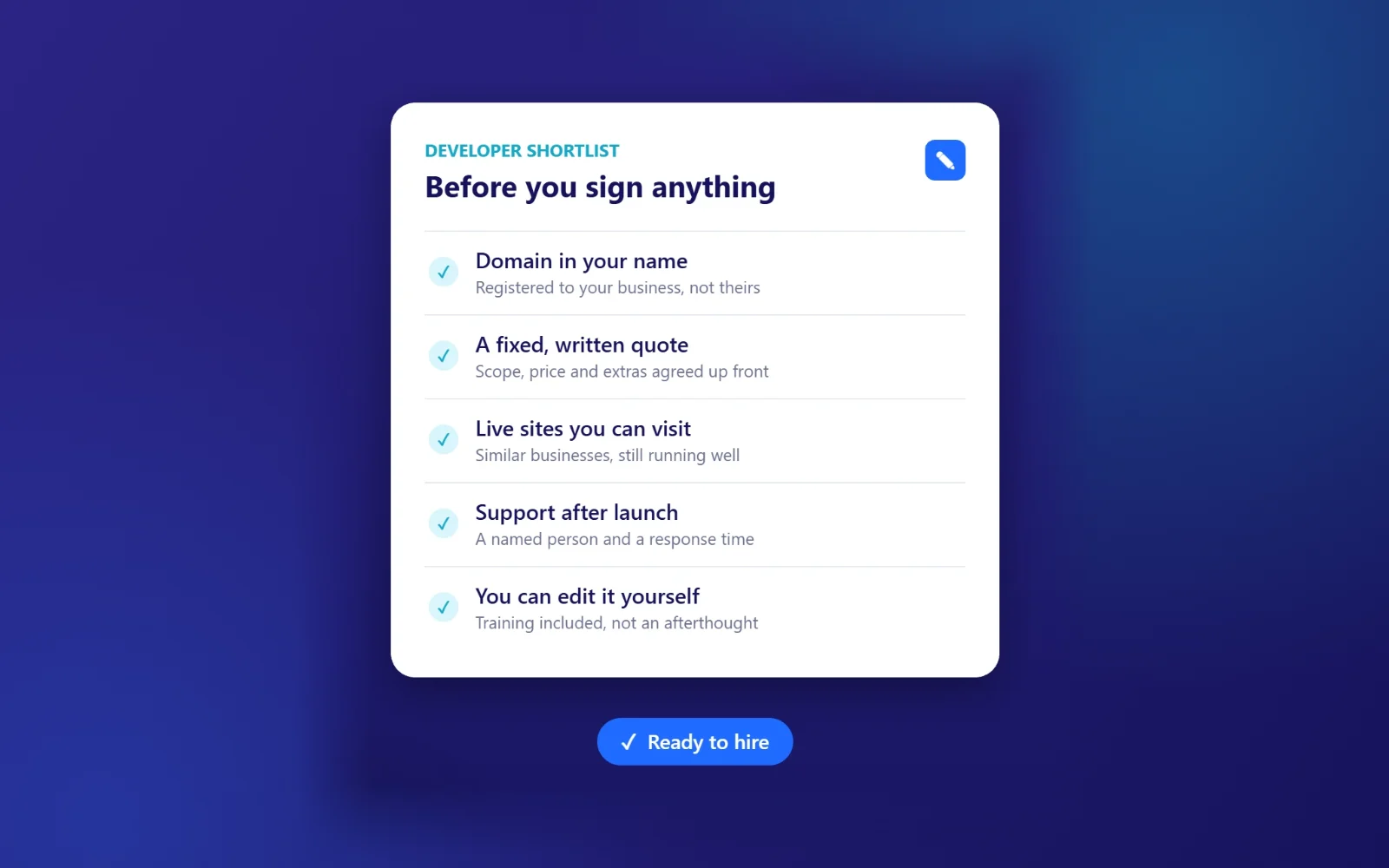
A good quote lists the pages, who writes the content, what SEO is included, how many rounds of changes you get, the timeline, the price and the running costs. If one quote is half the price of the others, find out what is missing. It is usually copy, SEO, support or ownership. Comparing written quotes is the fairest way to judge website developers for small business like for like, because it strips out who was most charming on the call.
Step 5: Agree ownership before you pay
The domain, hosting account, website files and admin logins should all sit in your business’s name, with the developer added as a user. You can check who holds a .uk domain on Nominet. This one step would have saved Dave months of hassle.
What good website developers for small business will ask you
You can learn as much from a developer’s questions as from their answers. The good ones want to understand your business before they talk about colours or plugins. Expect questions like these:
- Who are your best customers, and how do they find you now?
- What is the one thing you want a visitor to do?
- Which services make you the most money, and which do you want less of?
- Who will update the site, and how comfortable are they with it?
- What happens to an enquiry once it arrives?
If a developer jumps straight to a price without asking anything about your customers, they are quoting for a website, not for your business. The best website developers for small business clients treat the first call like a consultation, not a sales pitch.
Red flags when hiring website developers for small business
Most of these are easy to spot once you know to look.
- No fixed price. “It depends” is fine on a first call, not in a written quote.
- They register the domain for you, in their name. Kindly, but firmly, say no.
- No live examples. Every developer should be able to show sites that are still running.
- No mention of SEO, speed or mobile. These should be built in, not sold as extras later.
- Pressure to pay everything up front. A deposit is normal. Paying in full before you’ve seen anything is not.
- No plan for after launch. Ask who updates the site, who fixes it if it breaks and how fast they reply.
What a good developer does after launch
The launch is the point where most of the risk starts, not where it ends. Plugins need updating, backups need taking, forms need testing and someone needs to notice when something breaks.
The best website developers for small business owners offer a simple care plan that covers hosting, updates, backups and small changes for a fixed monthly fee. It is less exciting than a launch, but it is what keeps your site earning. Our own hosting and care plan starts from £39 a month for exactly this reason.
Can’t AI just build my website now?
AI website builders can produce a decent-looking draft in minutes, and they are improving fast. For a side project or a test idea, that might be enough.
For a business that relies on enquiries, the draft is the easy part. Someone still needs to decide what goes on each page, write words that sound like you, set up redirects from your old site, connect your forms and booking tools, make the site fast and keep it secure. Good website developers for small business now use AI to speed up the dull parts of the build, which should mean lower prices and quicker launches for you. It doesn’t replace the judgement. If you are curious where AI does pay off, read how AI can help small businesses.
How to be a client developers love working with
Projects run late far more often because of the client side than the developer side. You can keep yours on track with a few simple habits:
- Have your content ready. Photos, service descriptions, prices and reviews in one shared folder before kick-off.
- Name one decision maker. Feedback from three partners who disagree can add weeks.
- Give feedback in batches. One clear list per round beats twenty separate emails.
- Stick to the agreed scope. New ideas are welcome, but add them to a phase two list rather than the launch.
- Turn feedback round quickly. A week’s delay on your side is a week’s delay on launch.
Should you choose a local developer?
Local developers know your area, your competitors and how people in your town search. You can meet face to face, and they often have a stake in their own reputation nearby. That said, a good remote developer can serve you just as well over video calls.
What matters is responsiveness and understanding of your market, not postcode. If you are in Newcastle, our page on web design in Newcastle shows how we approach local projects.
How Dave’s story could have ended
Picture the same three-van electrician with a one-page brief and three quotes in front of him. One is cheap but vague. One is expensive and full of jargon. The third gives a fixed price, lists every page, registers the domain in his company’s name and includes a care plan with a named contact.
He picks the third. The site isn’t the cheapest, but a year later it still works, he can update his prices himself, and when a form stops sending, someone fixes it the same day. That’s what good website developers for small business actually sell: not a website, but one less thing to worry about.
Frequently asked questions
How much should a small business pay a website developer?
Most UK small businesses pay £1,000 to £5,000 for a brochure website from a freelancer or small agency, plus £150 to £600 a year in running costs. Simple sites can start from around £500.
Is it better to hire a freelancer or an agency?
Freelancers are usually cheaper and more personal. Agencies offer more resilience and a wider range of skills. For most local businesses, a well-reviewed freelancer or small agency is the sweet spot.
How long does it take a developer to build a small business website?
Four to eight weeks is typical for a five to fifteen page site. Read how long it takes to build a website for a stage-by-stage timeline.
What should be in a contract with a web developer?
The scope, price, payment stages, timeline, number of revision rounds, who owns the site and domain, what happens if either side ends the agreement and what support is included after launch.
Where can I find reliable website developers for small business near me?
Start with recommendations from businesses you trust, then search Google for website design plus your town and read the reviews. Always click through to live sites the developer has built before you get in touch.
Do website developers for small business also handle SEO?
Many include SEO basics such as page titles, speed and mobile design. Ongoing SEO, like local rankings and content, is usually a separate service. Ask exactly what is included. Our SEO services page explains the difference.
Free first call
Talk to a developer who answers in writing
Shortlisting website developers for small business? Send us your brief and we’ll reply with a fixed price, a list of what’s included and clear ownership terms. No pressure, and no jargon.
Book a free callNo obligation. A reply within one working day.