
Knowing the right questions to ask a web designer is the easiest way to avoid an expensive mistake. Most website problems we’re asked to fix, from slow sites to lost domains, could have been spotted on the first call with a few direct questions.
This guide gives you 20 questions to ask before hiring a web designer, grouped by topic, with what a good answer sounds like and the red flags to watch for. Print it, keep it next to you on the call, and compare designers on their answers, not just their prices.
Key takeaways
- Ask to see real, live websites they’ve built, and check how those sites perform on a phone.
- Make sure your domain, hosting and accounts will be in your name.
- Get a fixed, written quote that lists exactly what’s included, including copy, SEO and training.
- Ask what happens after launch: updates, support, costs and how easy it is to leave.
Questions about their experience
1. Can I see websites you’ve built for businesses like mine?
Ask for live links, not screenshots. Open them on your phone during the call. Are they fast? Is it obvious what the business does and how to get in touch? A designer who has worked in your industry will already understand your customers.
2. Can I speak to one of your clients?
A confident designer will happily put you in touch with a past client. Ask that client whether the project ran on time, whether the price changed, and whether the site brings in enquiries.
3. Who will actually build my site?
Some agencies sell the project and pass it to a junior or a subcontractor. That isn’t always bad, but you should know who you’ll deal with day to day and who to contact when something goes wrong.
4. Are you a registered business?
Check the company on Companies House if they’re a limited company, look for genuine reviews, and make sure there’s a real person behind the brand.
Questions about cost
5. Is the quote a fixed price?
You want one written figure for the agreed scope, not an hourly estimate that can drift. Ask what would change the price, and how changes are charged.
6. What exactly is included?
Check for the number of pages, copywriting, photos, SEO setup, contact forms, booking or shop features, training and launch support. Anything not listed should be assumed not included.
7. What will it cost to run each year?
Domain, hosting, updates, email, paid plugins or apps. A good designer will give you a clear annual figure. Our guide to how much a website costs in the UK explains typical running costs.
8. How do payments work?
A deposit with the balance on launch is common and fair. Be wary of paying everything upfront to someone you’ve never worked with.
Questions about ownership
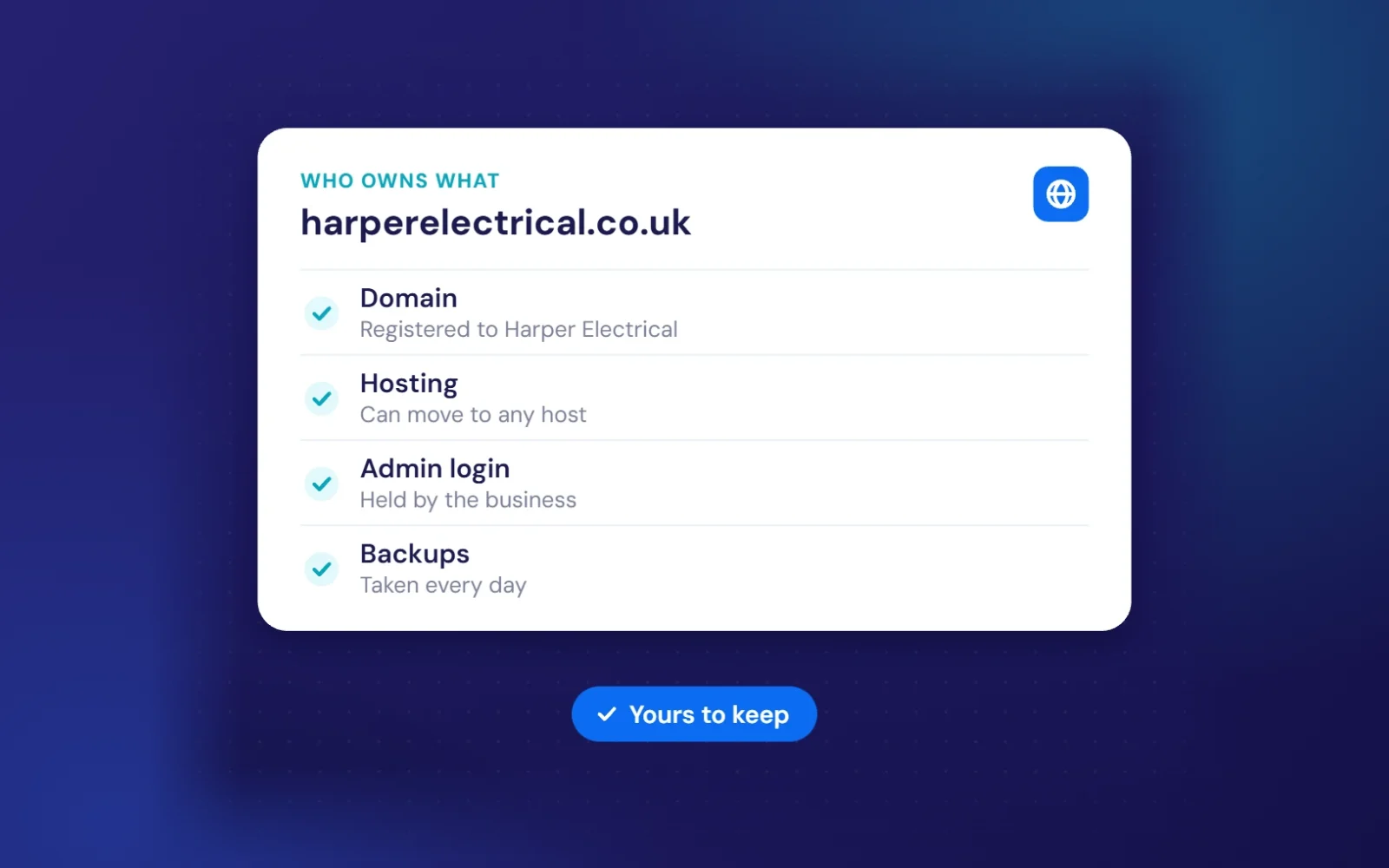
9. Will the domain be registered in my name?
This matters more than anything else on the list. One of the most common problems we fix is a domain registered years ago by a designer who can’t be reached. For .uk domains, you can check who holds the registration through Nominet, the .uk registry.
10. Who owns the website and content?
You should own the design, the words, the photos you supply and the site files once you’ve paid. Ask for this in writing.
11. Can I move my site to another host or designer?
The honest answer depends on the platform. WordPress sites can move anywhere. Website builders like Wix don’t offer a full export. Our comparison of WordPress vs Wix vs Squarespace covers this in detail.
12. Whose accounts will analytics and Search Console be in?
Yours, with the designer added as a user. That way your data stays with you whoever looks after the site.
Want to hear our answers to all 20? We’re happy to go through them on a free call, with a fixed quote at the end if it’s a good fit.
Questions about SEO and results
13. How will the site help me get found on Google?
Listen for specifics: page titles, a page for each main service and area, fast mobile pages, structured data and a Google Business Profile. Vague promises about “SEO-friendly” sites aren’t enough. Our page on website design and SEO shows what should be built in.
14. Will you keep my existing Google rankings?
If you already have a website, the designer should plan redirects from old page addresses to new ones. Ask exactly how they’ll do it.
15. How will we know if the site is working?
A good designer will set up tracking for form submissions and phone clicks, so you can see enquiries, not just visits.
16. Will the site be fast and accessible?
Ask how they handle image sizes, speed on mobile and accessibility. The Web Content Accessibility Guidelines are the recognised standard, and you can test speed yourself with PageSpeed Insights.
Questions about the process
17. How long will it take, and what do you need from me?
Get a realistic timeline and a list of what you need to provide. Our guide to how long it takes to build a website covers typical timelines.
18. Who writes the content?
Copy decides whether a site ranks and converts. Know whether you’re writing it, they are, or you’re sharing the work.
19. What about privacy, cookies and legal pages?
Your site needs a privacy notice and proper cookie consent if it uses non-essential cookies. The ICO sets out the rules. A designer won’t give legal advice, but should set up the pages and consent tools properly.
20. What happens after launch?
Ask about updates, backups, security, small changes and support, what it costs and whether there’s a contract. You should be able to leave easily. Our hosting and care plan, for example, is monthly with no contract.
Questions a good web designer will ask you
The first call should go both ways. A designer who only talks about colours and layouts is missing the point. The good ones ask about your business before they talk about design, because that’s what decides whether the site brings in work.
Expect questions like these, and be wary if you don’t hear any of them:
- What should the website achieve? More calls, quote requests, bookings or online sales.
- Who are your best customers? The type of person or business you want more of.
- Which areas do you cover? This shapes the location pages and local SEO.
- How do enquiries reach you now? Phone, email, social media or walk-ins.
- Who are your competitors? And what do customers like or dislike about them.
- What do you already have? Logo, photos, reviews, copy and any existing website.
- Who will look after the site afterwards? You, your team or the designer.
If you can answer these before the call, you’ll get a more accurate quote and a better website. It also shows the designer you’re serious, which tends to get you their best thinking rather than a generic proposal.
Red flags to watch for
- They won’t give a fixed price in writing.
- They plan to register the domain in their own name.
- There are no live examples, or the examples are slow on a phone.
- They promise first place on Google.
- The quote doesn’t mention copy, SEO or what happens after launch.
- They push a long contract for hosting or maintenance.
How to compare quotes
Put the answers side by side in a simple table: price, what’s included, ownership, timeline, running costs and support. The cheapest quote often leaves out copy, SEO or ongoing care, so it isn’t really cheaper. Choose the designer whose answers were clearest, whose past sites work well, and who you’d be happy to call when something goes wrong.
| Compare | Designer A | Designer B | Designer C |
|---|---|---|---|
| Fixed price | |||
| Pages, copy and SEO included? | |||
| Domain and accounts in my name? | |||
| Timeline | |||
| Yearly running costs | |||
| Support and contract |
Frequently asked questions
How do I choose a web designer for my small business?
Look at live sites they’ve built, speak to a past client, and compare fixed quotes on what’s included, who owns what and what happens after launch, not just price.
Should I hire a freelancer or an agency?
Freelancers and small studios usually suit small businesses best on cost and communication. Agencies make sense for larger projects needing a team. What matters most is the quality of their work and their answers to the questions above.
Free first call
Should I use a local web designer?
It helps if you want to meet in person or need local search knowledge, but a good remote designer can work just as well over video calls. Read our page on website design in the North East for how we work with local businesses.
Shortlisting web designers? Put us through the same 20 questions. We’ll answer every one, in writing, with a fixed price.
Book a free callNo obligation. A reply within one working day.