
How long does it take to build a website? For a small business, a simple one to three page site usually takes two to four weeks from the first call to launch. A larger brochure site with ten to twenty pages typically takes four to eight weeks, and online shops or sites with booking systems often take two to three months.
The build itself is rarely what holds things up. In our experience, the biggest factor is how quickly content, photos and feedback come together. This guide breaks a typical website timeline into stages, explains what speeds things up and slows them down, and covers what happens after launch, including how long Google takes to find your new site.
Key takeaways
- Simple sites take two to four weeks, larger sites four to eight weeks, and shops or booking systems two to three months.
- Content is the usual bottleneck. Having your words and photos ready can halve the timeline.
- Agree a launch date and a feedback schedule at the start, and keep rounds of changes to a set number.
- Google usually finds a new site within days, but ranking well takes weeks to months.
Typical website timelines
| Type of website | Typical timeline | What takes the time |
|---|---|---|
| One to three page site | 2 to 4 weeks | Copy, photos and one or two rounds of feedback |
| Brochure site, 10 to 20 pages | 4 to 8 weeks | Planning pages, writing copy for each service and area |
| Site with online booking | 6 to 10 weeks | Availability rules, payments, emails and testing |
| Online shop | 8 to 12 weeks | Products, payments, delivery and VAT settings |
| Custom agency project | Around 12 weeks or more | Discovery, custom design and development |
Bigger agency projects take longer: Startups.co.uk’s 2026 cost guide estimates a bespoke agency project at around 12 weeks of work.
The stages of a website project
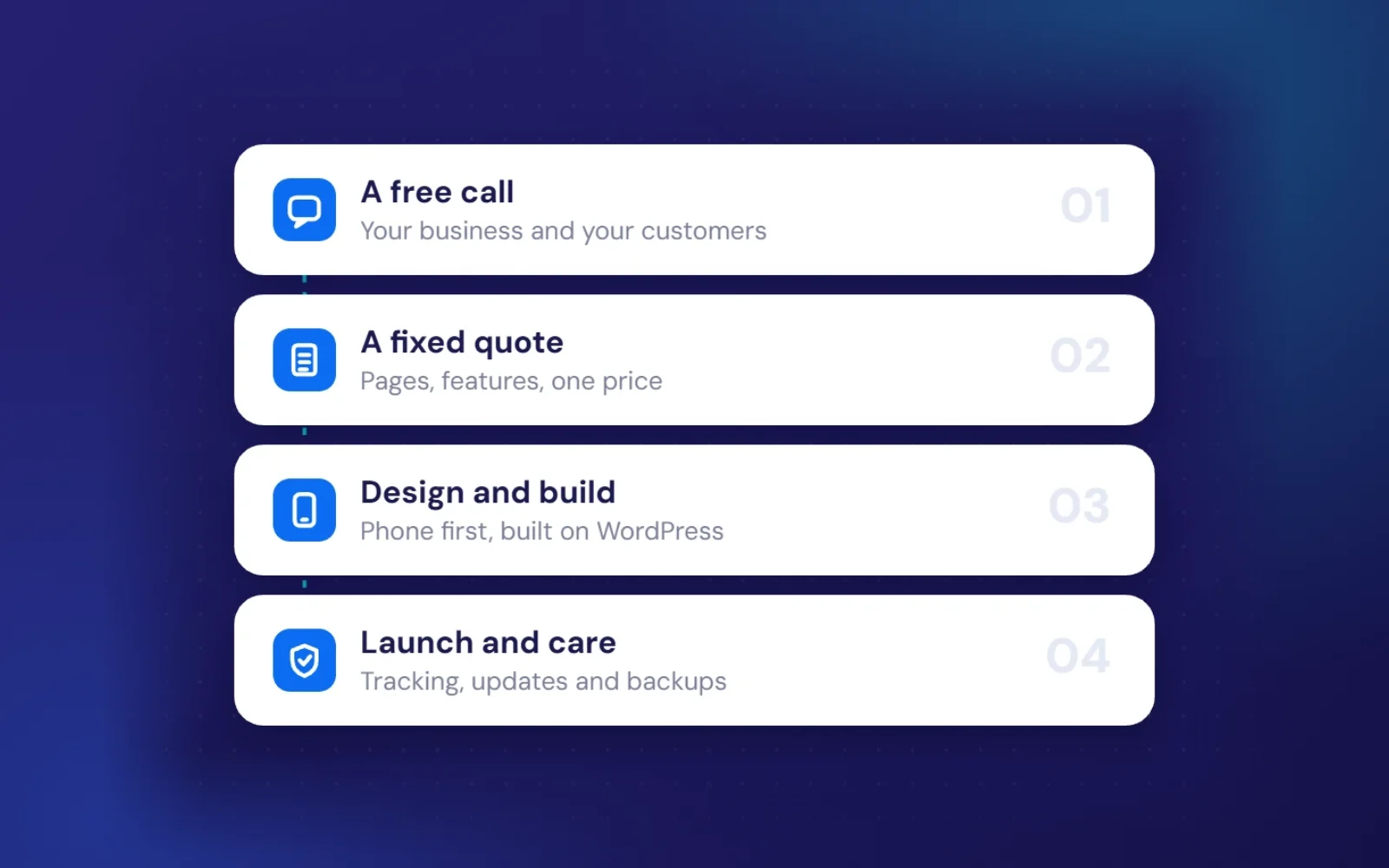
Every designer works slightly differently, but most small business projects follow the same six stages. Here’s what happens in each, and roughly how long it takes for a simple site.
1. Discovery call: day one
A short call to understand your business, your customers and what the website needs to do. A good designer will ask about your goals, the areas you cover, your competitors and how enquiries reach you now.
2. Quote and plan: one to three days
You receive a fixed quote and a simple plan: the pages, the features, who supplies what, and the timeline. Agree the launch date and when you’ll give feedback now, not halfway through.
3. Content and photos: the variable stage
This is where projects stall. Writing about your own business is harder than it looks, and photos of real work are always better than stock. If your designer helps with copy, this stage moves much faster.
4. Design and build: one to two weeks
The site is designed and built, usually on a private link you can view. For a simple site, the build itself is often a few days of focused work.
5. Feedback and changes: three to seven days
You review the site and send changes. One consolidated round of feedback is far quicker than a stream of separate emails, so gather everyone’s comments first.
6. Launch and handover: one to two days
The site goes live on your domain, forms are tested, analytics and Google Search Console are connected, and you’re shown how to make simple updates. Domain changes can take up to 48 hours to work everywhere, so avoid launching the day before a big promotion.
Need a site live by a certain date? Tell us your deadline on a free call and we’ll tell you honestly whether it’s realistic, and what you’d need to have ready.
What slows a website project down
- Waiting for content. The most common delay by far. Start gathering photos and notes before the project begins.
- Too many decision-makers. Agree who signs off, and collect everyone’s comments in one place.
- Changing the brief mid-build. New pages or features are fine, but they add time. Save nice-to-haves for after launch.
- Domain and email access. If nobody knows the login for your domain, recovering it can take days or weeks. Check now.
- Third-party accounts. Booking platforms, payment providers and mailing tools often need verification, which can take a few days.
How to speed up your website build
- Write a short list of your services, the areas you cover and what makes you different.
- Collect 10 to 20 real photos of your work, your premises and your team.
- Gather three to five of your best reviews.
- Find your logins for your domain, current website and Google Business Profile.
- Pick one person to give feedback and sign off.
- Choose two or three websites you like, and say why.
With those ready on day one, a simple site can realistically go live in under two weeks.
What happens after launch
Launching is the start, not the end. A few things happen in the weeks that follow.
Getting found on Google
Once your sitemap is submitted in Search Console, Google typically discovers a new site within days. Ranking well is slower. Google’s own Search Central documentation says crawling can take from a few days to a few weeks, and competitive local searches often take three to six months to settle.
Your Google Business Profile
Link your new site to your Business Profile on day one, and ask a few recent customers for reviews. For local businesses, this often brings enquiries in faster than the website itself. Our local SEO service covers this in detail.
Measuring enquiries
Set up form submissions and phone clicks as tracked events so you can see what’s working. If visits arrive but enquiries don’t, our guide to website visits but no enquiries walks through the fixes.
Looking after the site
Plugins, themes and platforms need updating regularly to stay secure. Either schedule it yourself or use a care plan. Ours covers hosting, updates, backups and small fixes for £39 a month with no contract, as explained on our website design and hosting page.
An example two-week timeline
Here’s how a simple three-page site can come together in two weeks when everything runs smoothly. It assumes your photos, logins and a rough list of services are ready at the start.
| Day | What happens |
|---|---|
| Day 1 | Discovery call and fixed quote agreed |
| Days 2 to 4 | Page plan, copy drafted and photos chosen |
| Days 5 to 8 | Design and build on a private preview link |
| Day 9 | You review the site and send one round of feedback |
| Days 10 to 11 | Changes made, forms and speed tested on mobile |
| Day 12 | Launch, Search Console and Business Profile connected |
| Days 13 to 14 | Handover, training and final checks |
How long does a website redesign take?
A redesign takes about as long as a new build, plus a little extra for one crucial job: protecting what your current site has already earned. If your old pages rank on Google or have links from other websites, changing their addresses without planning can wipe that out overnight.
- List every current page. Your sitemap or Search Console shows what Google knows about.
- Map old addresses to new ones. Every old page should redirect to its closest new equivalent with a permanent redirect.
- Keep what works. Pages that bring in traffic and enquiries should keep their topic, even if the design changes completely.
- Check after launch. Watch Search Console for errors in the first few weeks and fix anything that slipped through.
Allow an extra few days for this on most small business redesigns. It’s the cheapest insurance you can buy for your rankings.
Fast versus rushed
Some companies advertise websites in 48 hours. It’s possible, usually with a template, your logo dropped in and placeholder text. The trouble is that the parts that make a website work, clear copy, local SEO and proper testing, are exactly the parts that get skipped. A two to four week timeline for a simple site gives enough time to do those properly without dragging on.
If budget is part of the decision too, our guide to how much a website costs in the UK covers typical prices and running costs.
Frequently asked questions
How long does it take to make a website for a small business?
Usually two to four weeks for a simple site and four to eight weeks for a larger brochure site, depending mostly on how quickly content and feedback are ready.
Can a website be built in a week?
A simple site can be, if all the content, photos and logins are ready on day one and feedback is quick. Rushing usually costs you in copy quality and SEO.
How long does a website redesign take?
Similar to a new build, plus time to move content and set up redirects from old page addresses, so you don’t lose existing Google rankings.
Free first call
How long before my new website shows up on Google?
Usually within days once it’s submitted in Search Console. Ranking well for competitive searches typically takes a few weeks to a few months.
Ready to plan your website? We’ll give you a fixed price and a realistic launch date on a free call.
Book a free callNo obligation. A reply within one working day.