

Is it safe to use AI with customer data? Yes, it can be, if you choose the right accounts, only share what a task needs and keep a person checking anything important. The risk isn’t AI itself. It’s pasting personal information into tools whose terms you haven’t read, on accounts nobody manages.
This guide explains what UK GDPR expects when you use AI, what changed under the Data (Use and Access) Act 2025, which data should never go into an AI tool, and a practical checklist you can work through in an afternoon. It’s general guidance rather than legal advice, so speak to a solicitor about anything specific to your business.
Key takeaways
- Under UK GDPR, you stay responsible for customer data you put into AI tools, even when someone else runs the tool.
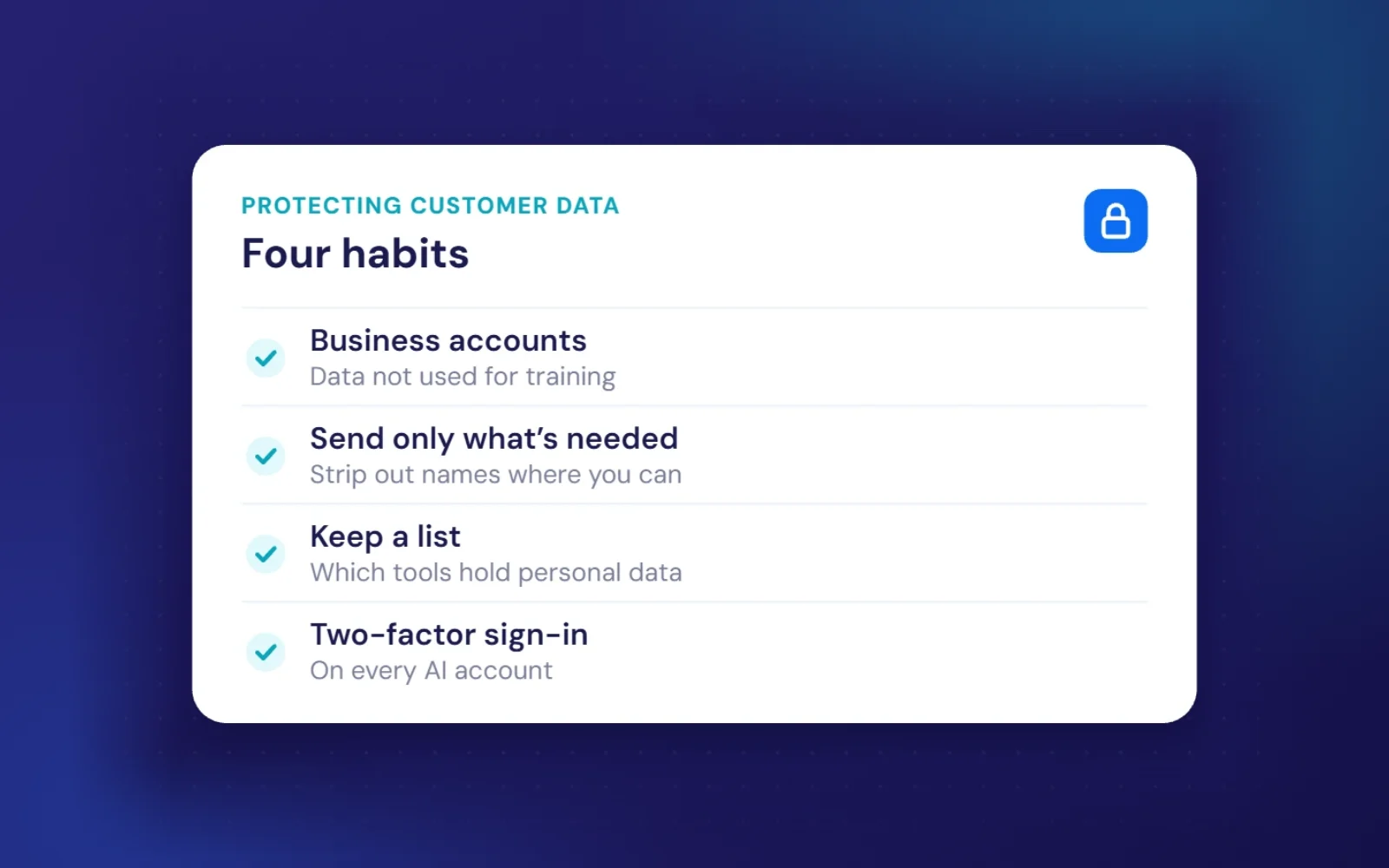
- Use business plans whose terms say your data isn’t used to train models, and switch on two-factor authentication.
- Strip names, contact details and anything sensitive before pasting, unless the task genuinely needs them.
- Keep a person in charge of decisions that significantly affect people, and tell customers how you use AI.
Why this matters for small businesses
Small firms are not too small to be targets. The government’s Cyber Security Breaches Survey 2025 found that 43% of UK businesses had a cyber security breach or attack in the previous 12 months. Phishing was by far the most common, affecting 85% of those businesses, and 42% of small businesses identified phishing attacks.
AI adds new ways for data to leak: an employee pastes a customer complaint into a free chatbot, a shared login is never changed when someone leaves, or an automation emails the wrong person. At the same time, confidence is low. The Simply Business 2026 SME Insights Report found only 19% of small business owners feel very confident using AI day to day.
Phishing attacks remain the most prevalent and disruptive type of breach or attack.
Cyber Security Breaches Survey 2025, GOV.UK
What UK GDPR says about AI and customer data
UK GDPR doesn’t ban AI. It applies the same principles to AI as to any other way of handling personal data. For a small business, five of them matter most:
| Principle | What it means when you use AI |
|---|---|
| Lawful basis | You need a valid reason to use the data, such as a contract or legitimate interests, and the AI use should fit what customers would reasonably expect. |
| Transparency | Your privacy notice should say you use AI tools to process data, and for what. |
| Data minimisation | Only send the AI what the task needs. A summary of a complaint rarely needs the customer’s address. |
| Security | Protect accounts with strong passwords and two-factor authentication, and control who has access. |
| Accountability | Keep a simple record of which tools handle personal data, and why. |
Crucially, you remain the controller. If an AI provider mishandles data you gave it, the ICO will still look at whether you chose and used that provider sensibly. The ICO’s guidance on AI and data protection sets out what regulators expect in more detail.
What changed with the Data (Use and Access) Act 2025
The Data (Use and Access) Act 2025 received Royal Assent on 19 June 2025, with changes phased in over the following year. Three are relevant to AI:
- Automated decisions. The rules on decisions made solely by automated processing are now more permissive, but you must still tell people about significant decisions, let them challenge them and let them ask for a human to step in.
- Complaints. Organisations must have a way for people to complain about how their data is used, such as an online form, and tell them the outcome.
- Recognised legitimate interests. A new lawful basis covers specific purposes like crime prevention and safeguarding. It isn’t a general licence to use data however you like.
For most small businesses using AI for admin and drafting, the practical effect is modest. If you let AI make decisions about people on its own, such as rejecting job applicants or refusing service, the safeguards above apply.
Free versus business AI accounts
This is the single most important choice. Free and personal plans of popular AI assistants may use your conversations to improve their models unless you change a setting. Business plans from the main providers generally say they don’t, and give you admin controls over who can use them.
| Question to check | Why it matters |
|---|---|
| Is my data used to train models? | You don’t want customer details becoming part of someone else’s product. |
| Where is data stored and processed? | Transfers outside the UK need appropriate safeguards in the provider’s terms. |
| How long is it kept, and can I delete it? | You need to honour deletion requests from customers. |
| Can I manage users centrally? | So you can remove access the day someone leaves. |
| Is there a data processing agreement? | It sets out the provider’s obligations to you as the controller. |
Not sure which tools are safe for your business? We set up AI automations on business accounts you own, with sensible data handling built in. Book a free call and we’ll talk it through.
Data you should never paste into an AI tool
- Health information, including allergies and medical notes
- Payment card numbers, bank details and passwords
- Information about children, unless you have a clear lawful basis and safeguards
- Criminal records, ethnicity, religion, sexuality or other special category data
- Anything covered by a confidentiality agreement with a client
If you need AI to help with a task involving these, it’s worth getting advice first and considering a data protection impact assessment.
A practical checklist for using AI safely
- List every AI tool used in the business, including the ones staff use on their own.
- Move work onto business plans with clear data terms, and close personal accounts used for work.
- Turn on two-factor authentication for every AI and automation account.
- Agree what can and can’t be pasted, and put it in a one-page AI policy.
- Remove names and contact details before pasting, unless the task needs them.
- Update your privacy notice to mention AI tools and what they’re used for.
- Keep a person checking anything that goes to customers, involves money or affects someone significantly.
- Review access every quarter and when anyone leaves.
- Know how to report a breach. Notifiable breaches must be reported to the ICO within 72 hours.
- Train your team on phishing. The NCSC Small Business Guide is free and practical.
You can see how we handle this ourselves in our AI use policy.
How to write a one-page AI policy for your team
An AI policy sounds like something only large companies need, but a single page stops most problems before they start. It gives staff permission to use AI where it helps, and clear limits where it doesn’t. Keep it short enough that people actually read it.
A good small business AI policy answers six questions:
- Which tools are approved? Name them, and say that work must happen on business accounts, not personal ones.
- What can be shared? For example, general questions, anonymised summaries and your own marketing copy.
- What must never be shared? Health details, payment information, passwords and anything confidential to a client.
- Who checks the output? Anything sent to a customer, involving money or affecting a person needs a named person to review it.
- How do we tell customers? Point to the privacy notice and keep the wording up to date.
- What do I do if something goes wrong? Who to tell, how quickly, and where breaches are logged.
Review the policy every six months. AI tools change their features and terms often, and a setting that was safe last year may have moved. When you update the policy, check your privacy notice still matches what you actually do.
Training doesn’t need to be formal either. A 20-minute team session walking through the policy, with real examples from your business, does more than a long document nobody opens. Ask people which AI tools they already use. The answers are often surprising, and it’s far better to know than to guess.
Safe ways to use AI with customer data
Plenty of useful AI work involves customer information and is perfectly reasonable when it’s set up properly. Examples we build regularly include:
- Drafting replies to enquiries for a person to approve before sending
- Sorting incoming emails into enquiries, invoices and suppliers
- Summarising call notes and logging them against the right customer
- Sending booking confirmations, reminders and review requests
What these have in common: the data stays in tools you control, the AI only sees what it needs, and a person approves anything that matters. For more ideas, read how AI can help small businesses, or see where AI pays back first on our page about AI automation for small businesses.
Choosing an AI consultant who takes data seriously
If you bring in outside help, ask three questions: whose accounts will the automation run on, where will customer data go, and what happens when the AI gets something wrong? The answers should be your accounts, a clear list of providers, and a human check. Our guide to choosing an AI consulting company covers the rest.
Frequently asked questions
Can I use ChatGPT with customer data?
You can, but use a business plan with admin controls and clear data terms rather than a free personal account, only share what the task needs, and mention AI tools in your privacy notice.
Do I need to tell customers I use AI?
Your privacy notice should explain how you use personal data, including AI tools that process it. If AI makes significant decisions about people on its own, you must also tell them and let them ask for a human review.
What happens if AI causes a data breach?
Treat it like any other breach: contain it, assess the risk to the people affected, and report it to the ICO within 72 hours if it’s likely to cause them harm. Keep a record either way.
Free first call
Is AI covered by UK GDPR?
Yes. Whenever an AI tool processes personal data, UK GDPR applies, and the business using the tool is usually responsible for how that data is handled.
Want AI that saves time without worrying about data? We build automations on accounts you own, with a person checking what matters, from £750 each.
Book a free callNo obligation. A reply within one working day.
